Lifestyle
Giving Thanks to the Tesla Village

They say it takes a village to raise a child. I say it takes a village to raise a young car company. A village to handle advertising for the company, so that it doesn’t have to spend big bucks on traditional advertising. A village to help potential owners understand that they too can be free of gas – a novel concept that requires a little faith to fully embrace.
And it was that village that led to my husband and I taking the plunge on a car with a price tag of nearly triple that of the vehicle it replaced. That village that has contributed to our ownership experience wildly exceeding our very high expectations.
First, there came a test drive. After having seen the car in person in November of 2012 at an event, I left scratching my head, interest definitely piqued. Fast forward to Spring 2014, and I convinced the old ball and chain we needed to drive it. There was a lot of soul searching and numbers crunching in the months to follow and we landed in a magical place where hopes, dreams and fears are shared. That is, the forums section of the Tesla Motors website. There, owners and enthusiasts answer newbie questions and share stories. In August, a fine man organized a coffee meet up in the Philadelphia suburbs. One veteran owner and Supercharger pro joined us from a road trip that had taken him to Atlantic City, which was already 2,000 miles away from his home. We chatted about charging and batteries and road trips. Most of all, we chatted about how this was “the best” car any of them had ever driven. Needless to say, meeting real life owners was the exact push we needed. Our order was placed the following morning. To those gentlemen, I say thank you.
Then came the waiting. In October, Elon showed us the D. Between that and the time of the quarter we made our order, our wait was longer than usual for a domestic delivery. 108 days actually. Visiting the Tesla forum became a daily ritual for me. I even attended one more meet up, this time as an actual reservation holder. I also commiserated with others who saw their delivery projection slip from November to December, as Tesla shifted production to accommodate a new motor configuration. Aside from filling my time, I got to learn everything about the car. The mythical “range anxiety” concept proved to be a phenomenon often reserved for potential owners and detractors, not so much once you actually have the car and understand how to plan. To every forum contributor, I say thank you.
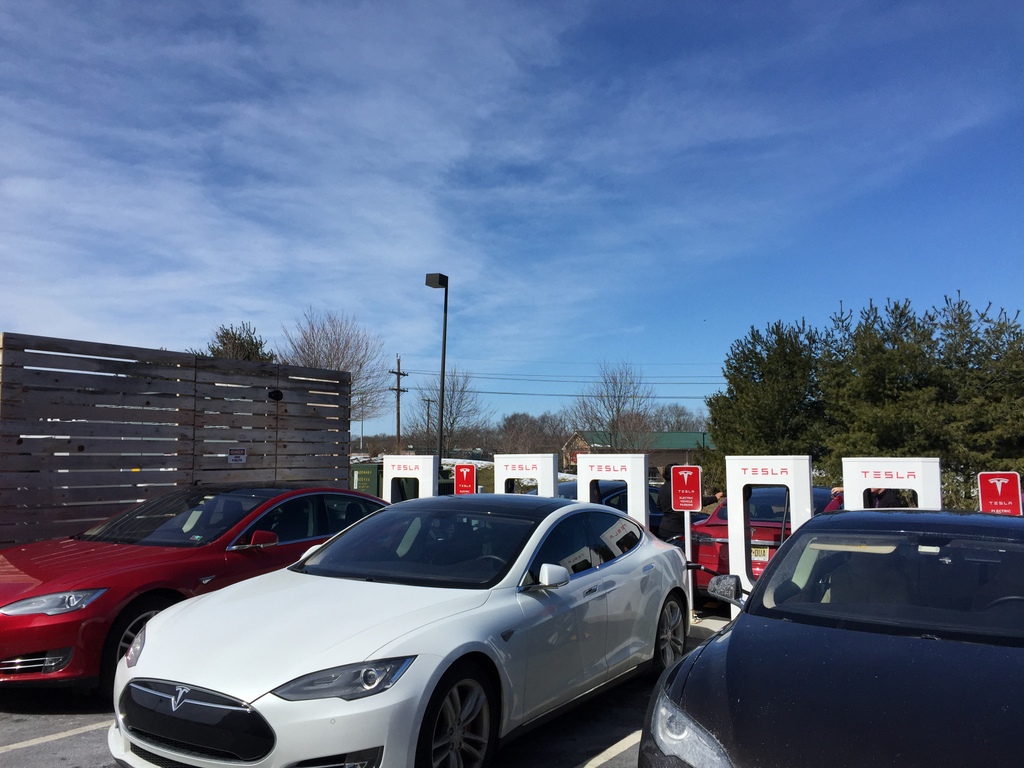
Next came the disappointment. The Tesla supercharger map advertised the charger we needed the most as being completed within 2014. Allentown, PA – midway between our Philadelphia home and the driveway/garage-less home of my in-laws – was lit up with a little red dot. Weeks turned to months and 2014 came and went. Finally in the summer of 2015, it was confirmed: the location fell through and the scouting process had to start all over. Every trip we take there requires us to borrow someone’s car to drop our Tesla off at a L2 charger 10 miles away. The Supercharger team has been working extremely hard and scouted a location that will actually work even better for folks traveling North and South along the Pennsylvania Turnpike. They even hit a snag with township zoning board approval that cost the process an entire month, which I know was as frustrating to them as it was to owners counting on that location. To Max and Jesse (who I bugged about this) and the whole Tesla Supercharger team responsible for a whopping 556 supercharging locations to date, I say thank you.
Then came the kindness of a stranger. This summer, my husband and I were headed to Jersey Shore to celebrate with some friends. Two of those friends were coming from Texas with their 1-year old and it was our Model S that would take the 5 of us from Philly to the shore. There are no Superchargers along the way and were no L2 chargers in any convenient location. After making mention of this on the forums, a fellow owner reached out with a solution. That solution was his own home just a short walk from the hotel we were staying in. (Which oddly had no outlets anywhere near the parking spaces.) We touched base a bit about when we would come and his level of accommodation was extraordinary. He moved his own Model S to the street and left his charge cable outside. We parked, took enough juice to get us home with a comfortable buffer, and were on our way without ever having met this kind owner in person. To him, I say thank you.
Last month came Autopilot. It has proven to be the source of countless hours of fun, the inspiration to start making videos, and yet another layer of safety to keep Model S occupants as far away from potential injury as possible. To the engineers and programmers, testers, visionaries and everyone else at Tesla responsible for making this system a reality, I say thank you.
Most recently came protection over profits. After a single vehicle in Europe experienced a detached seat belt situation resulting in no injury, Tesla decided to recall 90,000 vehicles to check them. Last I heard, no other defects had been found. In addition to checking cars at service centers everywhere, Tesla has even taken to sending testers to Superchargers to reach more vehicles and provide no disruption to owners. To the members of the Tesla leadership team that acted swiftly, the number-crunchers that allowed caution over costs, and every employee pulling hard on a belt, I say thank you.
Finally, a great big thank you to the readers. I am now fully entrenched in this wonderful community of Tesla owners and enthusiasts and can only hope that I contribute to someone else’s decision to jump into the future and experience the Tesla life for themselves.


Lifestyle
Tesla makes the cut on California’s newest EV Rebate program
California just signed a $270 million EV rebate into law and it starts this summer.

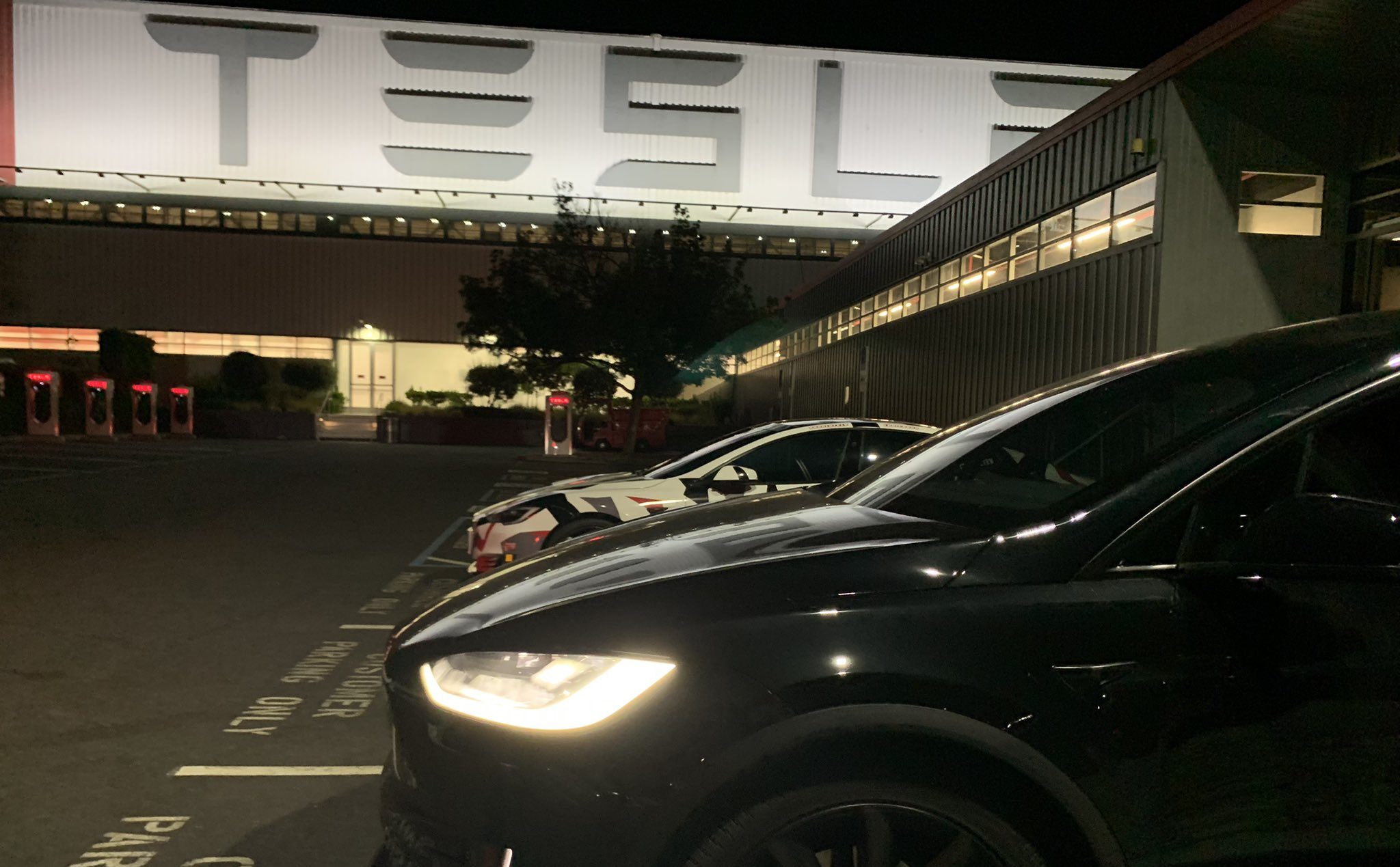
California Governor Gavin Newsom signed SB 168 into law on Monday, July 13, 2026, creating a $270 million EV rebate program that delivers money directly at the dealership rather than as a tax credit applied months later. The program, called MyFirstEV, is funded equally by California’s state budget and participating automakers, with each contributing $135.5 million to make the math work.
The timing is directly tied to the loss of federal support when the $7,500 federal EV tax credit ended, removing the most significant consumer incentive that had driven EV adoption in the U.S. California, which accounts for roughly one-third of all EVs sold nationally, moved to fill that gap with a state-level replacement.
The rebate structure is straightforward. First-time EV buyers can receive $3,500 off any new battery-electric vehicle with an MSRP up to $50,000. Used EVs priced at $25,000 or below qualify for a $1,750 rebate. The credit is applied at the point of sale, which removes the friction of the old federal system where buyers had to wait for tax season to see the benefit. The program goes live later this summer, with the California Air Resources Board expected to release full participation details next month.
California hits Tesla Cybercab and Robotaxi driverless cars with new law
For Tesla buyers, the implications are mixed. The Tesla Model 3 RWD at $42,490 and the Model 3 Long Range at $47,490 both fall under the $50,000 cap and would qualify for the full $3,500 rebate for first-time buyers. The Model Y, which starts at $44,990 after Tesla’s recent price adjustment, also qualifies. The Model X, Model S, and Cybertruck all exceed the cap and receive no benefit. As Teslarati has reported, the program also includes a carve-out exempting California-based automakers like Rivian and Lucid from the price cap entirely, a provision that puts Tesla at a disadvantage since it relocated its headquarters to Texas in 2021.
Other qualifying vehicles include the Chevrolet Equinox EV, Ford Mustang Mach-E, Hyundai Ioniq 5, Kia EV6, and Volkswagen ID.4.
Elon Musk
Tesla FSD is about to know your specific house and neighborhood better than any map
Tesla confirmed it is building a feature that lets you teach your car where to go.
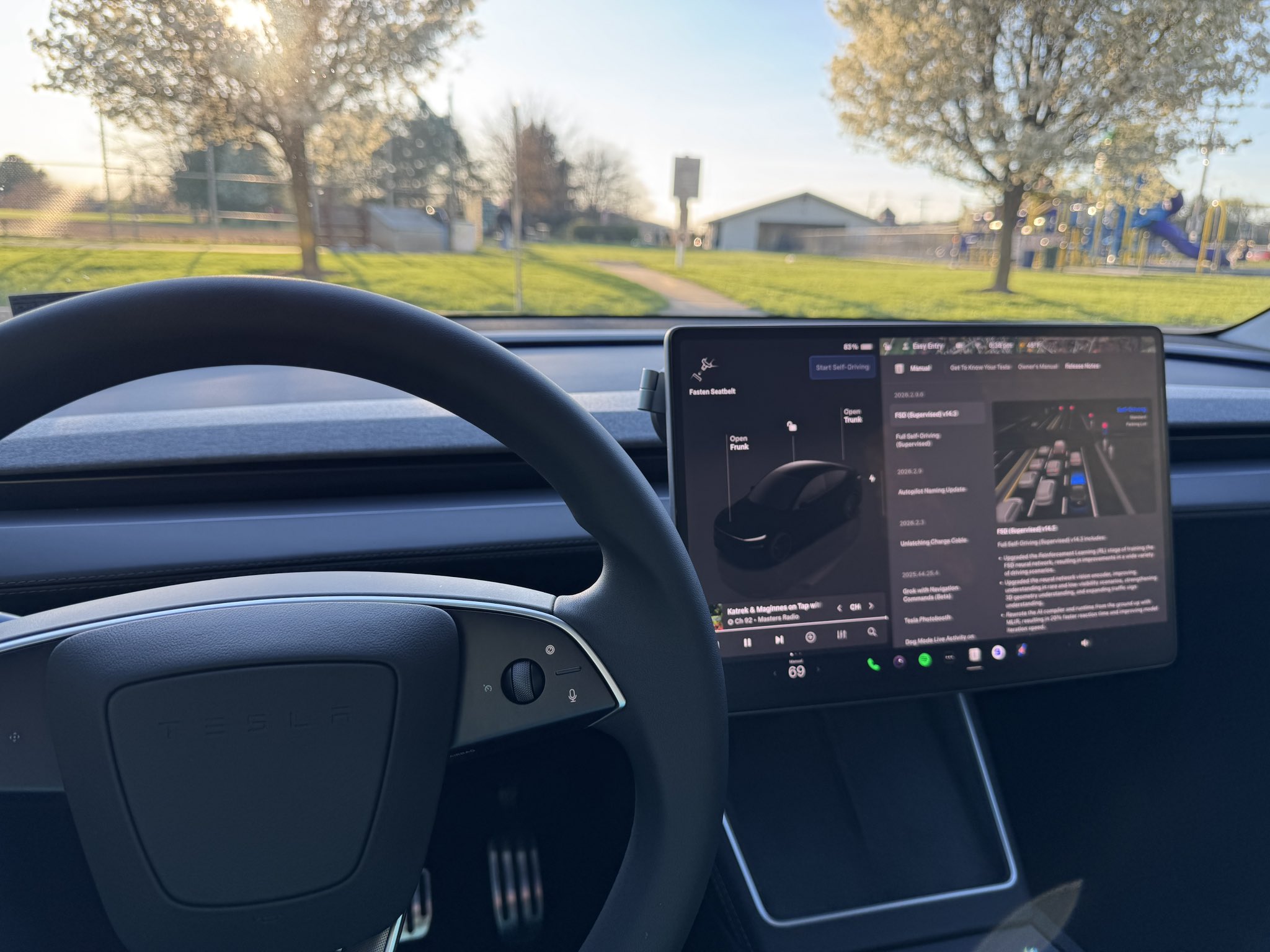
Tesla is building a feature that will let drivers talk to their car in plain language and teach it exactly what to do, with the vehicle remembering those instructions for every future trip. Tesla VP of AI Software Ashok Elluswamy confirmed it this week on X after a user pointed out one of FSD’s most persistent real-world limitations is that the system has no way to receive contextual instructions the way a human driver would.
“FSD would be twice as useful in neighborhoods if I could actually talk to the car and tell it which driveway to pull into, the same way I would with a person driving me home. Right now, there isn’t really an input for telling Tesla what color the house is or giving it specific context like that. Google Maps is also notorious for putting pins on houses that aren’t actually yours.” Tesla owner Chris further noted, “It would be so cool if I could talk to the car while going down my street and say something like, ‘It’s the white house on the left, just past that SUV,’ and then have FSD remember that for next time.”
FSD would be twice as useful in neighborhoods if I could actually talk to the car and tell it which driveway to pull into, the same way I would with a person driving me home.
Right now, there isn’t really an input for telling Tesla what color the house is or giving it specific…
— Chris (@ChrissGPT) July 8, 2026
This feature would carry more weight than it might seem. Grok has been available inside Tesla vehicles since July 2025, expanded to European vehicles in February 2026, and gained a hands-free “Hey Grok” wake word with location-based reminders and natural-language navigation in the Spring 2026 update. But up to this point, Grok has had no authority over how FSD actually drives. Lane changes, braking, speed, and parking maneuvers remain entirely within FSD’s autonomous decision-making loop. What Elluswamy confirmed is that the next step pushes Grok into a supervisor role, one that translates spoken intent directly into driving decisions.
Tesla teases greater Grok FSD integration and ‘Banish’ feature ‘in about 3 months’
Elluswamy acknowledged at a January 2026 conference that while fully integrated voice control is on Tesla’s roadmap, “it opens up an entire area of testing that we have to do. For example, you shouldn’t be able to tell the car to crash, and it shouldn’t crash.” Elon Musk subsequently confirmed on June 23 that Grok voice commands will pass to FSD’s planning layer by September 2026, a three month timeline from confirmation to deployment.
The deeper significance is what this does for Tesla’s AI training flywheel. Every time an owner corrects FSD with a spoken instruction and the car learns and remembers it, that interaction becomes a data point covering an edge case that no simulation or scripted test could have generated. A fleet of millions of Tesla vehicles crowdsourcing hyper-local contextual knowledge, which driveway, which gate entrance, which side of the street, builds a layer of geographic and behavioral intelligence that competitors without a comparable fleet simply cannot replicate at the same speed or scale.
As Teslarati has reported, Tesla’s Cybercab and robotaxi operations have expanded to Miami following the Austin launch, with rider profiles already collecting preference data. Voice-taught contextual instructions linked to individual rider profiles means a Cybercab could eventually know before it arrives exactly which entrance to use, where to wait, and how to navigate the final hundred feet of any trip it has made before.
Lifestyle
Tesla app update makes Robotaxi ownership make a lot more sense
Tesla’s app now shows a live indicator when your car is actively driving itself.
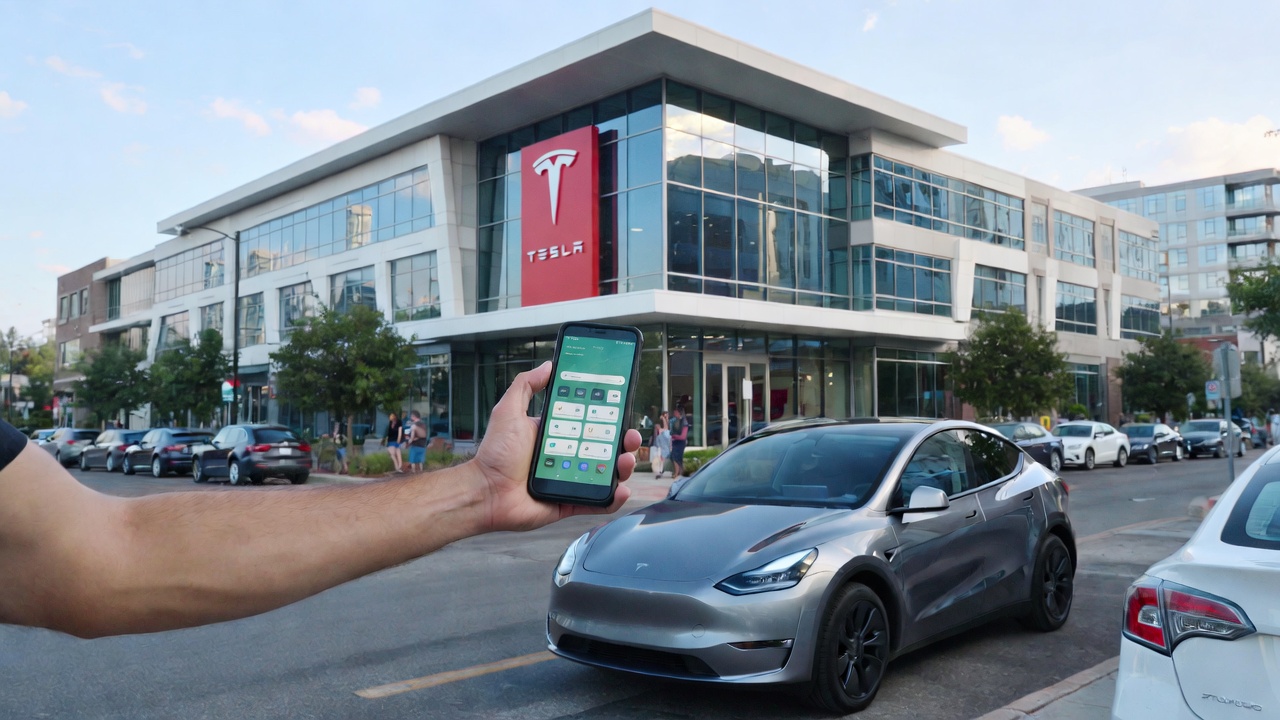
A recent Tesla app update, released last week (4.58.5), gives visibility on whether a vehicle is navigating in its semi-autonomous mode or being driven by a human driver. The updated app now displays a live “Self-Driving” indicator in bright blue text directly beneath the vehicle’s speed readout whenever Full Self-Driving is actively engaged, along with the signature glowing blue navigation path that FSD users see on the main touchscreen. It is a small visual update with meaningful implications for how Tesla owners monitor their vehicles remotely.
The feature was first spotted in the wild by X user Jordan Camina, who shared video of a Hardware 3 Model S displaying the new animation through the app while driving. That detail is significant because it confirms the update is not limited to newer HW4 vehicles. It works across hardware generations, and Tesla confirmed it will eventually support all vehicles regardless of chip platform once both the app and vehicle software are updated. The vehicle side requires software version 2026.20.6.1, which has reached nearly 40% of the fleet so far, as monitored by NotaTeslaApp.
The feature makes the most practical sense when viewed through the lens of Tesla’s expanding robotaxi operation. In a robotaxi context, the owner of a vehicle generating ride revenue has a direct financial and safety interest in knowing whether their car is operating under autonomous control at any given moment. The app’s new FSD indicator gives fleet owners exactly that visibility, the same way a logistics company monitors whether a delivery driver is following the planned route. It also carries implications for Tesla’s insurance model. Tesla’s own insurance product prices premiums in part based on FSD engagement rates, and real-time visibility into when FSD is active creates a feedback loop that could eventually tie directly into policy pricing. For individual owners who have opted their personal vehicles into the robotaxi network, the update effectively turns the Tesla app into a fleet management dashboard, one that tells you whether your car is earning money, whether it is driving itself to do it, and whether everything is operating the way it should from wherever you happen to be.
Tesla expands Robotaxi to Florida, marking its third state for autonomy
As Teslarati has reported, Tesla launched unsupervised robotaxi rides in Miami this summer, a milestone that makes a remote FSD status indicator significantly more practical than a cosmetic feature. When a vehicle is operating as a robotaxi without a driver present, the owner or fleet operator needs a reliable way to confirm autonomy is engaged. The app now provides exactly that.
As noted by NotATeslaApp, The update also arrived alongside a hint buried in the same app version that Tesla plans to use the cabin camera to verify driver identity before FSD can be activated. Pairing identity verification with a live autonomy status indicator points toward the infrastructure Tesla is building for a fleet of driverless vehicles that owners can monitor the way you would track a package delivery.

Tesla Full Self-Driving v14.3.5 Early Impressions: new features and early performance

Tesla makes the cut on California’s newest EV Rebate program


