Investor's Corner
HyperLoop Test Track Coming To California
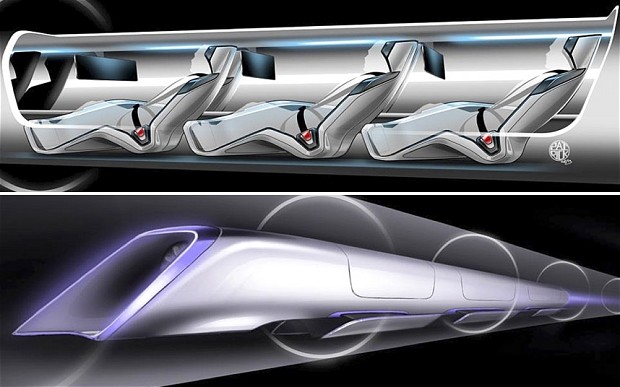
HyperLoop Transportation Technologies has purchased land in central California to build HyperLoop test track to see if the this nutty idea actually works.

HyperLoop Transportation Technologies has struck a deal to buy enough land near Interstate 5 in central California to build a 5 mile long HyperLoop test track, reports Navigant Research. It will cost about $100,000,000 and serve as a “proof of concept” facility for the HyperLoop idea proposed by Elon Musk in 2013. The money to pay for it is expected to come from an IPO later this year, with construction beginning in 2016.
If you’re not familiar with the HyperLoop, think of it as one of those pneumatic tubes that connect drivers and tellers at drive-thru banks, only hundreds of miles long and big enough to carry people. Musk thinks such a system could whisk passengers from LA to San Francisco in about 35 minutes at speeds up to 800 mph.
If that seems a little fantastic to you, remember this is the man who thought it was possible to build a rocket ship for a fraction of what it costs other companies — and then did it. Today, his SpaceX company has years of business worth billions of dollars booked, while those others are crying for customers. Saying “It can’t be done,” to Musk is like telling Congress to stop spending your money.
For all his genius, not even Elon Musk can overturn the laws of physics. All transportation devices have to deal with friction losses and wind resistance. As speeds increase, so does friction, but the real enemy of high speed travel is wind resistance. Aerodynamic loads increase with the square of speed. That’s why it takes 4 times as much power to punch a hole in the air at 100 mph than it does at 50 mph.
Source: ET3
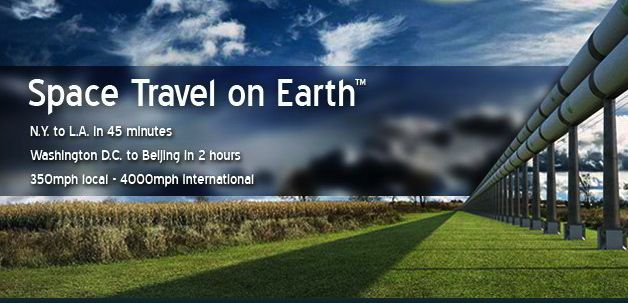
The HyperLoop doesn’t repeal the laws of physics; it finds new ways to minimize their effects. It’s one of those “Don’t raise the bridge, lower the river,” kind of things and it’s brilliant. Let’s start with wind resistance. The HyperLoop will consist of a steel tube hundreds of miles long that has a partial vacuum inside. Less air means less wind resistance. Less wind resistance means higher speeds with less power.
Part two of the plan eliminates all the wheels, axles and motors that cause friction in regular vehicles. Instead, the transportation modules inside the HyperLoop tube will “float” on a thin layer of air, slashing friction to nearly zero. Instead of motors, the train will be propelled by electrically powered linear accelerators installed along its entire length. Once again, the idea is brilliant. But will it work?
Musk says passengers in his HyperLoop will be whisked along in complete comfort. But skeptics point out that they will be sealed inside windowless pods during the journey. Those who suffer from claustrophobia shouldn’t buy a ticket. There will be no beverage service, no restrooms and no possibility of moving around during the journey. Furthermore, they will be bombarded by the sound of what little air is left inside the tube rushing by at near supersonic speeds.
While Musk assumes the ride will be serenely smooth, in reality the alignment of the tube will have to be virtually perfect over its entire length for that to happen. Hello? We are talking about California here, a state known for its frequent seismic activity. Then there are considerations like how to keep the HyperLink tube sealed against air leaks and safe from vandalism.
The test track is designed to answer all those questions and win over the doubters. If the idea is validated, Musk says a Hyperloop along the heavily traveled I 5 corridor could be built for about $8 billion. Contrast that with the $64 billion the Amtrak high speed rail line scheduled to begin construction soon is supposed to cost. When was the last time a government project came in on time and under budget? Of course, Musk’s numbers don’t include the costs of developing his idea and making it a reality.
Elon Musk’s greatest gift is spinning wondrous tales about what could be and convincing people to invest today in his promise of tomorrow. Then he uses the funds raised to make tomorrow happen. So far, more people have made money investing in Musk and his dreams than have lost it. When the HyperLoop Transportation Technologies IPO takes place, will you be on the phone to your broker, placing a “buy” order? Or do you think the HyperLoop is mostly hype and hyperbole?
The problem with predicting the future is the future is so stubbornly unpredictable.


Elon Musk
Tesla confirmed HW3 can’t do Unsupervised FSD but there’s more to the story
Tesla confirmed HW3 vehicles cannot run unsupervised FSD, replacing its free upgrade promise with a discounted trade-in.

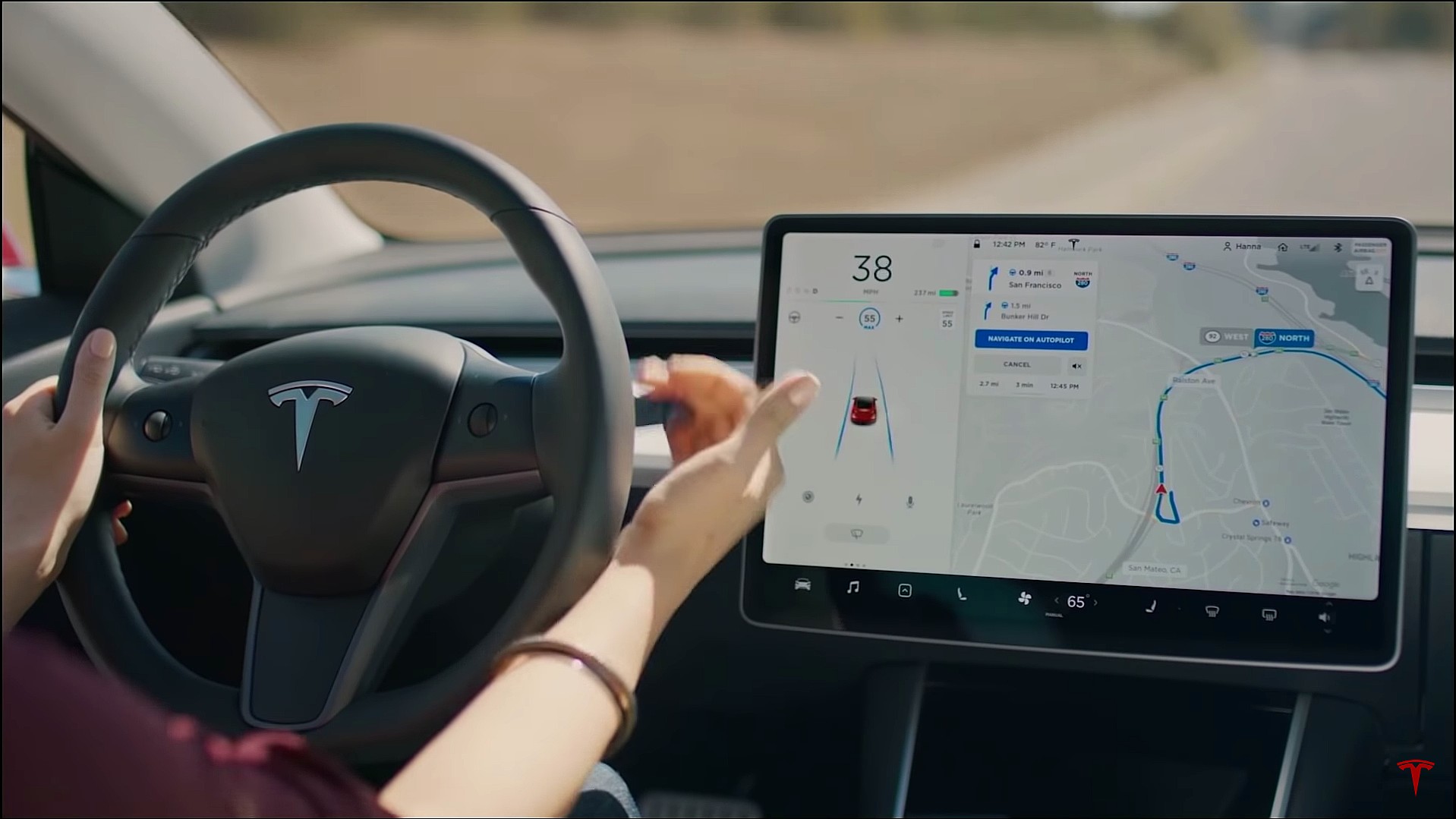
Tesla has officially confirmed that early vehicles with its Autopilot Hardware 3 (HW3) will not be capable of unsupervised Full Self-Driving, while extending a path forward for legacy owners through a discounted trade-in program. The announcement came by way of Elon Musk in today’s Tesla Q1 2026 earnings call.
🚨 Our LIVE updates on the Tesla Earnings Call will take place here in a thread 🧵
Follow along below: pic.twitter.com/hzJeBitzJU
— TESLARATI (@Teslarati) April 22, 2026
The history here matters. HW3 launched in April 2019, and Tesla sold Full Self-Driving packages to owners on the understanding that the hardware was sufficient for full autonomy. Some owners paid between $8,000 and $15,000 for FSD during that period. For years, as FSD’s AI models grew more demanding, HW3 vehicles fell progressively further behind, eventually landing on FSD v12.6 in January 2025 while AI4 vehicles moved to v13 and then v14. When Musk acknowledged in January 2025 that HW3 simply could not reach unsupervised operation, and alluded to a difficult hardware retrofit.
The near-term offering is more concrete. Tesla’s head of Autopilot Ashok Elluswamy confirmed on today’s call that a V14-lite will be coming to HW3 vehicles in late June, bringing all the V14 features currently running on AI4 hardware. That is a meaningful software update for owners who have been frozen at v12.6 for over a year, and it represents genuine effort to keep older hardware relevant. Unsupervised FSD for vehicles is now targeted for Q4 2026 at the earliest, with Musk describing it as a gradual, geography-limited rollout.
For HW3 owners, the over-the-air V14-lite update is welcomed, and the discounted trade-in path at least acknowledges an old obligation. What happens next with the trade-in pricing will define how this chapter ultimately gets written. If Tesla prices the hardware path fairly, acknowledges what early adopters are owed, and delivers V14-lite on the June timeline it committed to today, it has a real opportunity to convert one of the longest-running sore subjects among early adopters into a loyalty story.
Tesla (NASDAQ: TSLA) reported its earnings for the first quarter of 2026 on Wednesday afternoon. Here’s what the company reported compared to what Wall Street analysts expected.
The earnings results come after Tesla reported a miss on vehicle deliveries for the first quarter, delivering 358,023 vehicles and building 408,386 cars during the three-month span.
As Tesla transitions more toward AI and sees itself as less of a car company, expectations for deliveries will begin to become less of a central point in the consensus of how the quarter is perceived.
Nevertheless, Tesla is leaning on its strong foundation as a car company to carry forward its AI ambitions. The first quarter is a good ground layer for the rest of the year.
Tesla Q1 2026 Earnings Results
Tesla’s Earnings Results are as follows:
- Non-GAAP EPS – $0.41 Reported vs. $0.36 Expected
- Revenues – $22.387 billion vs. $22.35 billion Expected
- Free Cash Flow – $1.444 billion
- Profit – $4.72 billion
Tesla beat analyst expectations, so it will be interesting to see how the stock responds. IN the past, we’ve seen Tesla beat analyst expectations considerably, followed by a sharp drop in stock price.
On the same token, we’ve seen Tesla miss and the stock price go up the following trading session.
Tesla will hold its Q1 2026 Earnings Call in about 90 minutes at 5:30 p.m. on the East Coast. Remarks will be made by CEO Elon Musk and other executives, who will shed some light on the investor questions that we covered earlier this week.
You can stream it below. Additionally, we will be doing our Live Blog on X and Facebook.
Q1 2026 Earnings Call at 4:30pm CT https://t.co/pkYIaGJ32y
— Tesla (@Tesla) April 22, 2026
Elon Musk
Tesla Earnings: financial expectations and what we should to hear about
In terms of discussions, Tesla earnings calls are usually a great time to get some clarification on the company’s outlook for its current and future projects.

Tesla (NASDAQ: TSLA) will report its earnings for the first quarter of 2026 this evening after the market closes, and analysts have already put out their expectations from a financial standpoint for the company’s first three months of the year.
Additionally, there will be plenty of things that will be discussed, including the recent expansion of the Robotaxi program, the Roadster unveiling, and Full Self-Driving (Supervised) approvals across the globe.
Financial Expectations
Wall Street consensus expectations put Tesla’s Earnings Per Share (EPS) at $0.36, while revenues are expected to come in around $22.35 billion.
This would compare to an EPS of $0.27 and $19.34 billion compared to Tesla’s Q1 2025. Last quarter, EPS came in at $0.50 on $29.4 billion of revenue.
Tesla beat analyst expectations last quarter, but the next trading day, the stock fell nearly 3.5 percent. We never quite can gauge how the market will respond to Tesla’s earnings; we’ve seen shares rise on a miss and fall on a beat.
It really goes on the news, and investor consensus, it seems.
What to Expect
In terms of discussions, Tesla earnings calls are usually a great time to get some clarification on the company’s outlook for its current and future projects. Right now, the big focus of investors is the Robotaxi program, the Roadster unveiling, and what the outlook for Full Self-Driving’s expansion throughout Europe and the rest of the world looks like.
Robotaxi
Tesla just recently expanded its unsupervised Robotaxi program to Dallas and Houston, joining Austin as the first cities in the U.S. to have access to the company’s ride-hailing suite.
Tesla expands Unsupervised Robotaxi service to two new cities
Some saw this move as a quick effort to turn attention away from a delivery miss and an anticipated miss on earnings. However, we’ve seen Tesla be more than deliberate with its expansion of the Robotaxi suite, so it’s hard to believe the company would make this move if it were not truly ready to do so.
The company is also working to expand its U.S. ride-hailing service outside of Texas and California, and recently filed paperwork to build a Robotaxi-exclusive Supercharger stall.
Expansion is planned for Florida, Nevada, and Arizona at some point this year, with more states to follow.
Roadster Unveiling
The Roadster unveiling was slated for April 1, and then pushed back (once again) to “probably late April,” according to Elon Musk.
It does not appear that the Roadster unveiling will happen within that time frame, at least not to our knowledge. Nobody has received media or press invites for a Roadster unveiling, and given the lofty expectations set for the vehicle by Musk and Co., it seems like something they’d want to show off to the public.
The Roadster has become a truly frustrating project for Tesla and its fans; evidently, there is something that is not up to the expectations Musk and others have. Meanwhile, fans are essentially waiting for something that is six years late.
At this point, also given the company’s focus on autonomy, it almost seems more worth it to just cancel it, remove any and all timelines and expectations, and surprise people with something crazy down the line, maybe in two or three years. There should be no talk of it.
Full Self-Driving Global Expansion
We expect Musk and Co. to shed some details on where it stands with other European government bodies, as it recently was able to roll out FSD (Supervised) to customers in the Netherlands.
Spain is also working with Tesla to assess FSD’s viability as a publicly available option for owners.
With that being said, there should be some additional information for investors as they listen to the call; no talk of it would be a pretty big letdown.
Optimus
There will likely be a date set for the Gen 3 Optimus unveiling, and we’re hopeful Tesla can keep that date set in stone and meet it. Not reaching timelines is a relatively minor issue, but a company can only do this for so long before its fans and investors start to lose trust and disregard any talk about dates.
It seems this is happening already.
Optimus has been pegged as Tesla’s big money maker for the future. The goals and expectations are high, but it is a privilege to have that sort of pressure when investors know the company’s capability.

Tesla’s biggest rivals fights charging wait times with a modern approach

Tesla wins big as NHTSA drops three-year, 120k unit probe against Model Y


